

The sexy ao dai, a phrase that seems to capture a beautiful contradiction, is the perfect introduction to the soul of Vietnam’s iconic national garment.
As someone from Huế, where the áo dài is treated with a lot of tenderness, here is how I honestly see it: the áo dài is alluring precisely because it never tries to be. It flatters by suggestion, not by exposure — and that restraint is exactly its power.
While the world of fashion often equates sensuality with revealing cuts and exposed skin, the Vietnamese Áo Dài (for those wondering, here’s how to pronounce ‘Ao Dai’ correctly) offers a profound and captivating counter-narrative.

It is a garment that covers the body from the neck to the ankle, yet is celebrated globally as one of the most subtly seductive and alluring national costumes. It doesn’t shout; it whispers. It doesn’t expose; it suggests.
This is the art of Vietnamese allure, a delicate dance between modesty and charm, grace and sensuality.

This article delves into the genius behind this paradox. We will deconstruct how the Áo Dài achieves its famous appeal, not through what it bares, but through what it celebrates.
Its magic lies in a trinity of elements: its revolutionary architectural design that honors the female form, the poetic language of its fabric that speaks to the senses, and the graceful, confident spirit of the Vietnamese woman who brings it to life.
This is a journey to understand how a garment can be conservative by design but utterly captivating in effect, redefining sensuality on its own elegant terms.
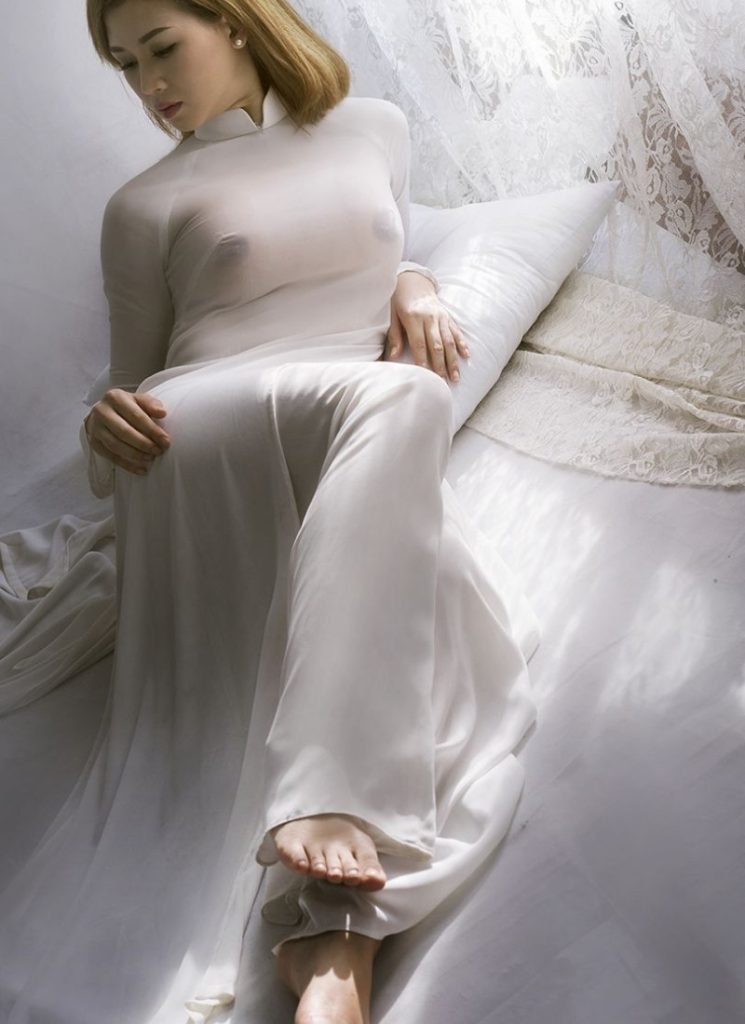
The Architecture of Allure: A Masterclass in Design
The allure of the Áo Dài is not an accident; it is the result of centuries of refinement, a masterpiece of tailoring that understands the female form intimately.
The design is deceptively simple—a long, tight-fitting tunic worn over flowing trousers—but its construction is a masterclass in celebrating curves.
These traditional design elements have evolved significantly throughout the history of the Ao Dai, resulting in the iconic silhouette we know today.

The “Second Skin” Fit
The foundation of the sexy ao dai silhouette lies in its form-fitting tunic. Unlike a loose-fitting dress, the top half of the Áo Dài is tailored to be a “second skin,” a gentle embrace that sketches the body’s natural lines without constricting them.
It gracefully follows the contours of the shoulders, bust, and especially the waist, drawing attention to the most feminine aspects of the figure.
This meticulous tailoring creates a powerful S-curve silhouette that is both elegant and undeniably sensual.

It honors the body, suggesting its shape and form in a way that is far more evocative than simply revealing it. The focus is on the overall shape, a continuous, flowing line that celebrates the woman’s natural grace.
The High Slit: A Dance of Concealment and Revelation

Perhaps the most ingenious and recognizable feature of the Áo Dài is its high slits. The tunic is split into two panels, a front and a back, from the waist down. These slits are not designed for exposure in the Western sense. Instead, their purpose is to create movement and suggestion. As the wearer walks, the delicate fabric panels float and part, offering a fleeting, graceful glimpse of the silk trousers (quần lụa) and the subtle curve of the hip.
This dynamic of “now you see it, now you don’t” is central to the garment’s charm. It’s a playful and poetic element that creates an aura of mystique.

The allure is in the motion, the gentle sway of the fabric that both conceals and reveals with every step.
This unique two-panel structure is one of the key differences between the Vietnamese Ao Dai and the Chinese Qipao, which typically features a slit on only one side of a single-piece dress. The Áo Dài’s dual panels create a symmetry and fluidity that is entirely its own.

The Poise of the Collar
The traditional Áo Dài features a high, Mandarin-style collar that fastens snugly on the side. This element serves multiple aesthetic purposes. It frames the face beautifully, elongates the line of the neck, and encourages the wearer to maintain a poised, upright posture.

This regal bearing adds a layer of confidence and elegance that is integral to the garment’s overall appeal.
While modern interpretations feature various necklines like boat-necks or V-necks, leading to many different types of Ao Dai you should know, the classic high collar remains a powerful symbol of dignified grace, adding a final touch of sophistication to the alluring silhouette.

The Language of Fabric: Weaving Sensuality
If the design is the architecture of the Áo Dài, then the fabric is its soul. The choice of material is critical in achieving the desired balance of modesty and allure, as it dictates how the garment drapes, flows, and interacts with the body and light.

While silk is the classic choice, the meaning behind various fabric choices for the Ao Dai can dramatically change its look and feel.
Silk: The Soulmate of the Áo Dài
Silk (lụa) is the quintessential fabric for a truly sexy ao dai, balancing grace with sensuality.

There is no other material that captures its essence so perfectly. Vietnamese silk is renowned for being soft, lightweight, and having a lustrous sheen.
When tailored into an Áo Dài, it cascades like liquid down the body. It’s not stiff; it breathes and moves, becoming a fluid extension of the wearer.
The sensory experience of silk is a key part of its appeal. It feels luxurious against the skin and catches the light with a soft glow, highlighting the curves of the body in a subtle, flattering way.

The fabric’s inherent softness allows it to drape perfectly, hinting at the form beneath without clinging ungracefully. This fluid dynamism is what makes a silk Áo Dài so captivating to watch in motion.
Modern Textures: A New Vocabulary of Charm
While silk remains the gold standard, contemporary designers have embraced a wider palette of materials to add new dimensions to the Áo Dài’s charm.

Chiffon and georgette offer an even lighter, more ethereal quality, creating soft, flowing silhouettes perfect for modern aesthetics. Velvet adds a sense of regal depth and luxury, its rich texture absorbing light to create a look of profound elegance.
In recent years, lace has been used to introduce a new vocabulary of romance and subtle transparency.
Often applied to the sleeves, the yoke, or as an overlay, lace allows for delicate, see-through details that are alluring without being overly revealing.

These modern fabric choices demonstrate the Áo Dài’s incredible versatility and its ability to adapt to contemporary fashion while retaining its core spirit of sophisticated allure.
The Spirit of the Wearer: The Woman Behind the Dress
A perfectly tailored Áo Dài made from the finest silk is still incomplete. The final, and most essential, element is the woman who wears it.

The garment is a canvas, and the wearer is the artist who brings it to life with her poise, her confidence, and her spirit. This is where the concept of duyên dáng becomes central to understanding Vietnamese beauty.
Duyên Dáng: The Essence of Vietnamese Grace
There is no single English word that perfectly captures the meaning of duyên dáng. It is a uniquely Vietnamese concept that describes a holistic kind of attractiveness—a blend of grace, charm, elegance, and subtle femininity.
It’s not about being the loudest person in the room, but about possessing a quiet, self-assured magnetism.

The Áo Dài is the physical embodiment of duyên dáng. It encourages this very quality in the woman who wears it. The restrictive, form-fitting nature of the dress means one cannot move hastily. It requires a measured, graceful gait.
The long panels demand a certain awareness of one’s movements. In this way, the dress and the wearer enter into a symbiotic relationship.
The garment transforms her posture and presence, and in turn, her graceful spirit breathes life into the fabric. Knowing how to wear the Ao Dai properly is about more than just the clothing; it’s about inhabiting this spirit of elegance.
Confidence in Motion
Ultimately, the allure of the Áo Dài comes from the confidence it inspires. When a woman wears a garment that has been tailored perfectly to her body, one that celebrates her unique shape and encourages graceful movement, she carries herself differently.

She stands taller, walks more deliberately, and exudes an aura of self-possession.
This quiet confidence is the ultimate accessory. It is the intangible quality that turns a beautiful dress into an unforgettable vision.
The true power of the “sexy ao dai” is not in its ability to attract glances, but in its power to empower the wearer, allowing her to express her femininity with a strength and grace that is profoundly, beautifully Vietnamese.
To maintain this beauty, it’s crucial to understand how to wash and care for your Ao Dai, ensuring the delicate fabric and form are preserved for years to come.
A Timeless Symbol of Elegant Power
In a world of fast fashion and ever-changing trends, the Áo Dài endures. It stands as a powerful testament to a different kind of sensuality—one based on suggestion rather than revelation, on grace rather than glamour, and on celebrating the female form rather than objectifying it.
The term “sexy ao dai,” when viewed through this cultural lens, is not about provocation. It is about a sophisticated and subtle allure, a celebration of a feminine power that is both timeless and profound.
It is, and always will be, a global symbol of elegance and a beautiful, flowing tribute to the captivating spirit of the Vietnamese woman.
About the Author
Alis is a Vietnamese áo dài enthusiast from Huế — the city long tied to the heart of the áo dài. Born in 1990 and a graduate of Huế University (2012), she created Alis Collection to document what she is learning about the áo dài and to share it with the community. She writes from genuine curiosity and careful research. Learn more about Alis · Read more of her guides.